Healthgineering vs. Healthineers
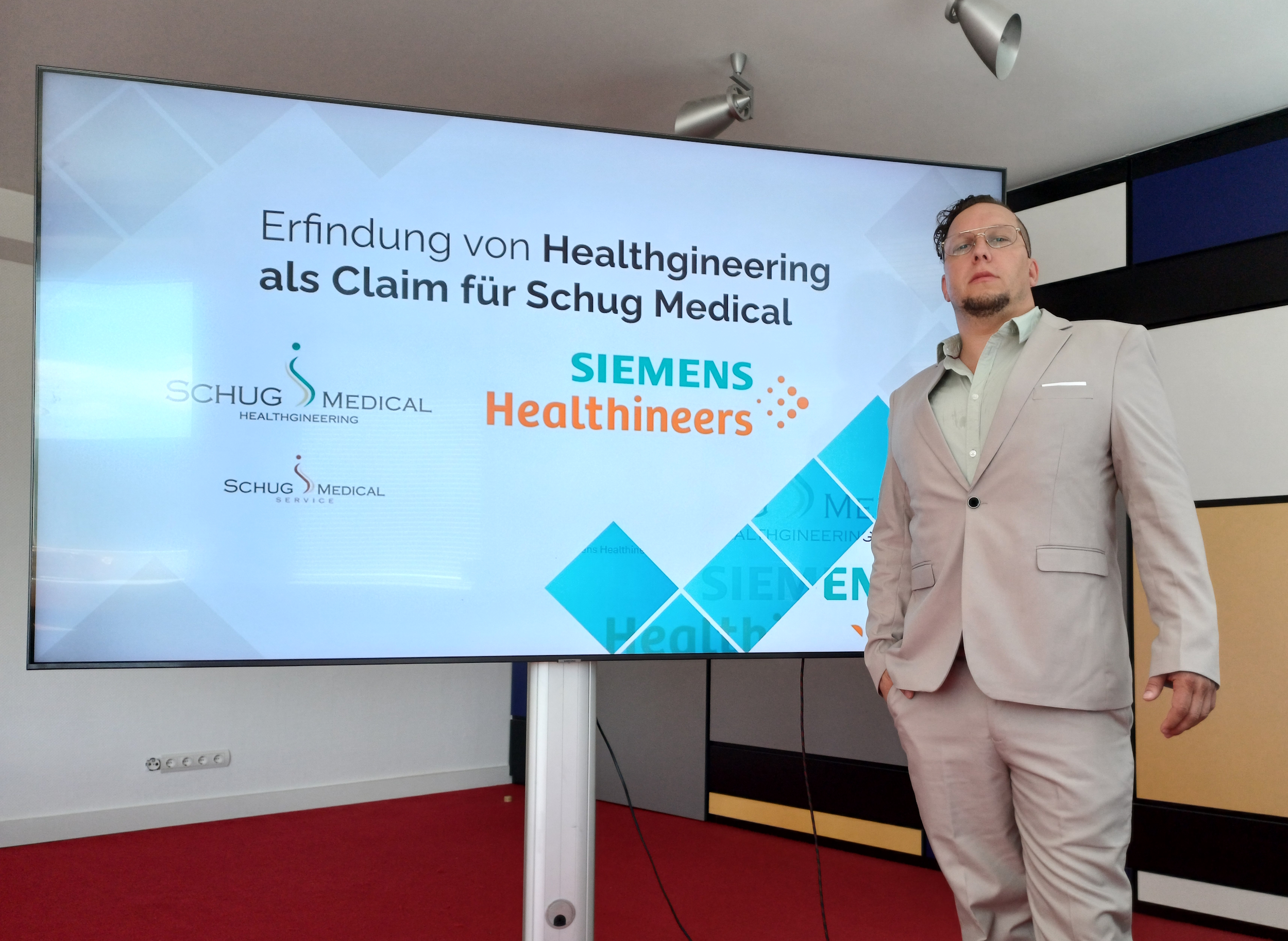
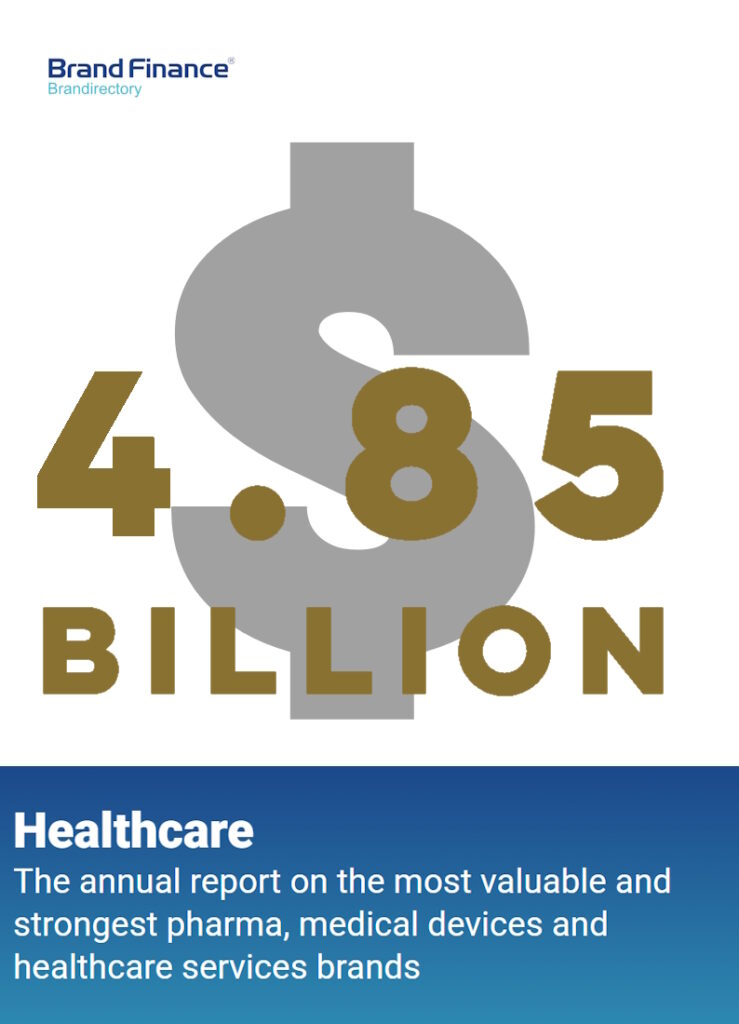
In 2012, I created the claim HEALTHGINEERING for the Schug Medical GmbH. Siemens has been using the term HEALTHINEERS for its medical technology division since 2016. This constitutes an unfair appropriation of the brand asset. Healthgineering forms the -ing suffix from which the noun Healthineers is derived in the first place. The amount in dispute determs to the reported brand equity of approximately $4.85 billion, as a legally binding recognition of authorship would deprive the defendant of the trademark rights to the brand asset worldwide.

A spin-off from Sanitätshaus Schug GmbH
Founded in 2012
Branding, including the “Healthgineering” claim, is legit (via invoice)
Spin-off from Siemens AG
Founded in 2016
Branding, including the name “Healthineers,” not legit (upon request)
The design was created by my former company, WEB WIRTSCHAFT E-BUSINESS MARKETING UG, for the client Sanitätshaus Schug GmbH, and is clearly documented by an invoice. I also refer to a YouTube video from the year 2013, in which the managing partner, André Friedrich, publicly promotes the brand using the claim.
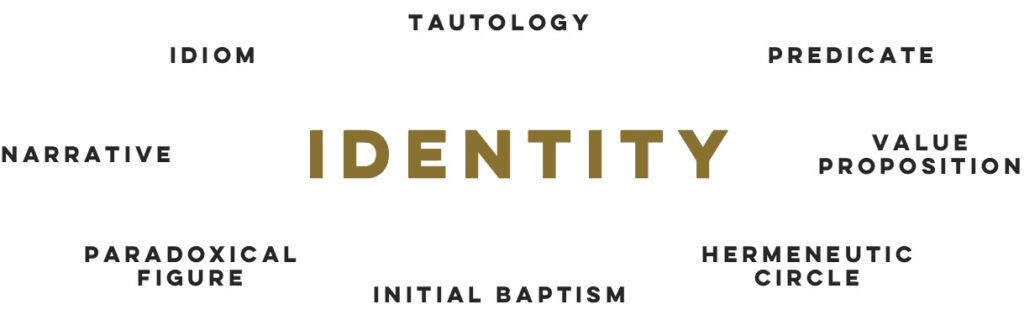
Claiming, in the process of founding a company, is effectively the intellectual demarcation of know-how within the lexical field of meaning. In brand strategy, the creator has positioned this paradoxical condensation as an expression of abstract work to generate differentiation and brand personality as an USP. In crafting this value proposition, the choice of the claim creates a strategic message that lends the company a certain degree of authenticity.
The role of brand assets is to construct meaning. “Healthgineering,” a claim that builds value through interpretation and trust, conveys a sense of purpose in a single word. A neologism that, in psychoacoustic perception, creates a mental anchor in the context of health and engineering when addressing hospital administrations and medical practice decision-makers.
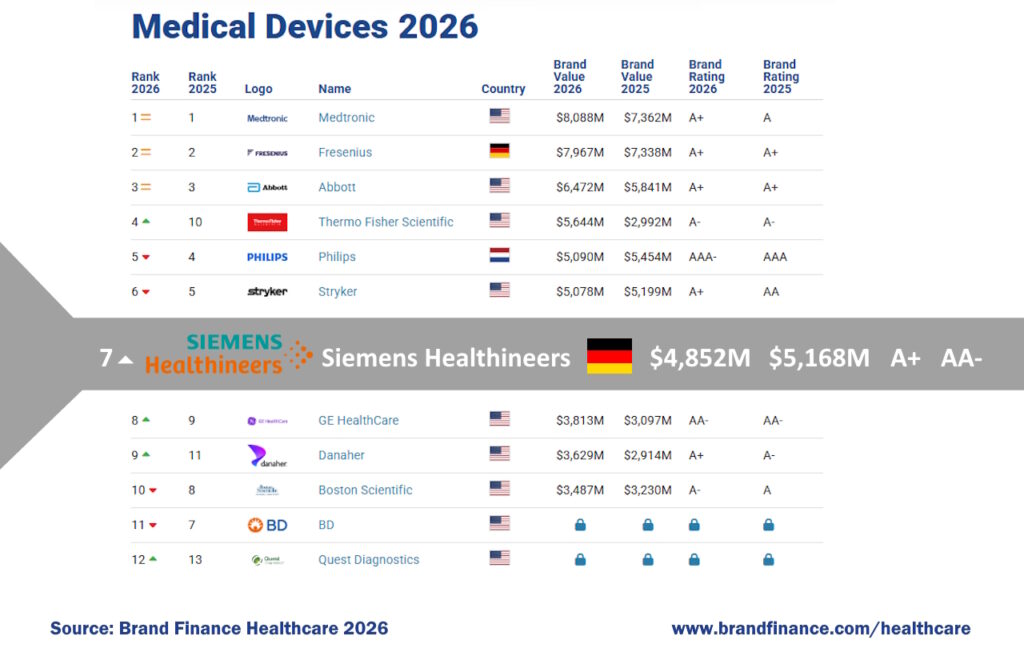
Siemens AG’s adoption of the brand asset by naming its medical technology division “Siemens Healthineers” results in significant legal violations. Based on the eligibility for protection under Section 2 of the German Copyright Act (UrhG), this constitutes violations of Sections 3, 4, 7, 12, 15, 16, 17, 23, and 97 of the UrhG, Sections 4 and 5 of the German Unfair Competition Act (UWG), Sections 17 and 30 of the German Commercial Code (HGB), and Sections 12 and 823 of the German Civil Code (BGB).
The unauthorized use, modification, and exploitation of the brand asset, as well as the resulting likelihood of confusion and misappropriation of the name, give rise to comprehensive claims for injunctive relief and damages, even far beyond Germany!

„According to the case law of the Federal Court of Justice, the decisive factor is that the work goes beyond mere craftsmanship or functional performance and exhibits a freely created, perceptible originality.“
The copyright eligibility of the claim at issue is determined by applying the standards set forth in the judgment of the Hanseatic Higher Regional Court of Hamburg dated August 29, 2024 (Case No. 5 U 116/23 – “Wir sind Papst”). According to Number 136–137 of that judgment, the level of creativity is determined by the relationship between the specific design and the existing repertoire of forms, as well as the given task.
A claim consisting exclusively of a single word stands out clearly from the usual range of forms in the advertising and marketing industry, as advertising slogans typically consist of multi-part word sequences or complete sentence structures. The deliberate reduction to a single, newly coined neologism therefore represents an independent creative decision that differs significantly from the range of creative approaches customary in the industry. As explained in detail, the term used also has multiple levels of meaning as well as an independent semantic message, thereby fulfilling the criteria for individual linguistic expression emphasized by the Hamburg Higher Regional Court (Section 2 of the German Copyright Act (UrhG)).
*The Berne Convention for the Protection of Literary and Artistic Works guarantees authors worldwide the right to pursue legal action under copyright law in their country of origin!
„Finally, the considerations set forth in Number 144–146 are also relevant. The court emphasizes that the adoption of a particular formulation by third parties can be a significant indication of the level of creativity.“
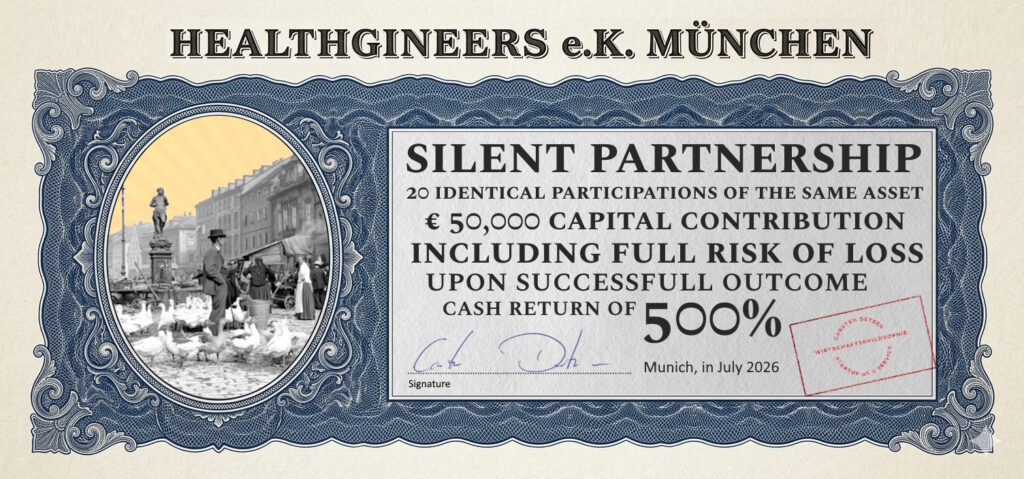
In order to obtain a legally binding decision regarding the authorship of the disputatious Brand-Asset, I will register a enterprise with the legal form of an e.K. in Munich. The chosen fictitious name “HEALTHGINEERS e.K.” will be rejected (§ 382 FamFG) by the registry court on the basis of § 30 HGB (distinctiveness and exclusivity). Then, I will file an appeal against this decision (§ 59 FamFG). Consequently, the case—along with my assessment of the authorship—will be referred to the Higher Regional Court (OLG) as the appellate court, compelling it to issue a legally binding decision.
Furthermore, I will seek court rulings in other countries regarding ownership of the brand asset through copyright and trademark litigation. In particular, a lawsuit in Switzerland is intended to serve as a review forum regarding the admissibility under corporate and trademark law, conducted at the same time and in the same manner. The goal is to establish leverage and threaten to have the Siemens Healthineers trademark removed from the Principal Register of the USPTO.
As a registered merchant (e.K.), I am offering a maximum of 20 identical shares in the same investment in the form of silent partnerships (§§ 230 ff. HGB). Each share is structured identically and provides for an attractive profit share of 500% upon the conclusion of a license agreement with Siemens Healthineers AG.
Legal Notice:
This offer is made pursuant to the de minimis exemption under § 2(1)(3)(a) of the German Investment Act (VermAnlG). Therefore, there is no obligation to publish a prospectus.
Warning:
The purchase of this investment involves significant risks and may result in the complete loss of the invested capital. The projected profit is not guaranteed and will be paid out only if the investment is successful.
Confidential Documents:
An invoice from Web Wirtschafts E-Business Marketing UG (insolvency in 2017) serves as proof of work and is provided along with the correspondence, including a legal statement from Siemens Healthineers AG.