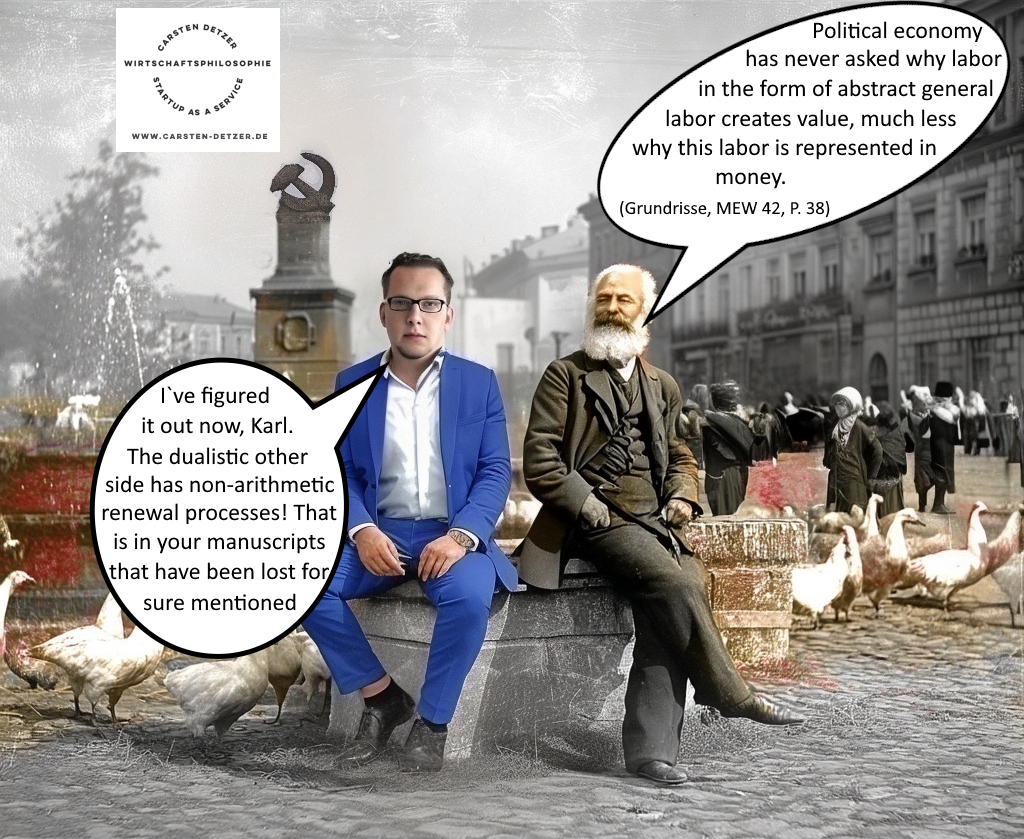
The question that Karl Marx posed in “Capital” and which remains unanswered to this day is:
“to demonstrate the genesis of this form of money, that is, to trace the development of the expression of value contained in the value relation of commodities from its simplest and most inconspicuous form to the dazzling form of money”
Admittedly, it’s a complicated way of putting it, but to summarize it quite simply: how does the intrinsic value of money arise?
To approach this, I would first like to describe what money is and highlight the two different perspectives on it, which run through economics and ultimately through all of science as a methodological dispute.
What all observers can agree on is that money is a medium that expresses the interaction of exchange. Goods and services are the actual money. However, the method to be used to determine exchange value is already part of the conflict.
The LTV’s theses already come significantly close to this intrinsic value, but were abandoned after the establishment of the substance of commodity value and its magnitude (concrete labor). Marx speaks of a mythic-religious meaning that exists on the part of capitalists as a commodity fetish.
I answer this socialist point of contention, as well as the question posed above by Karl Marx, which I have made the subject of my research, through a self-experiment with the theses of the Austrian School of Economics, which is on the side of subjective value theory, with a definition of abstract labor.
Karl Marx forged an intellectual bridge between mathematical topology and sociology, thus introducing a socialist concept that remains prevalent today in the understanding of the sphere of space and time. Proponents of this thesis use the resulting topological lasso to conclude that the economy is homeomorphic and can be shaped from the top down.
Before delving deeper into my positions, it is advisable to understand the scientific concepts of value-form analysis, subjective value theory, praxeology, the normative power of the factual (Jellineks), the macro-micro-macro model (Coleman’s bathtub), the price and value system (Sraffian), latent pattern maintenance, creative destruction and methodological individualism (Schumpeter), Keynesianism, a priori science, functionalism (Parsons), and the Mandeville paradox in order to gain a basic understanding.
Money is therefore a commodity, and we assess a commodity according to its Net Asset and its Capitalized Earnings. Net Asset includes both tangible assets, such as machinery, buildings, and goods, as well as intangible assets, such as intellectual property and know-how, and goodwill. Capitalized Earnings, on the other hand, describes the value of consumption—that is, the quantity of goods and services demanded by the market.
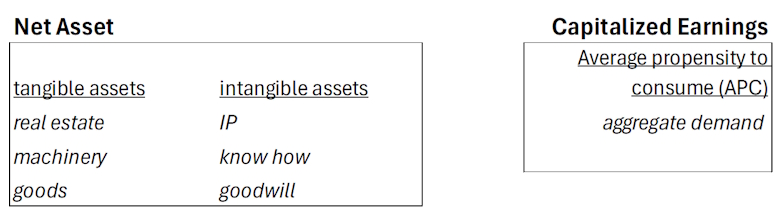
The question of intrinsic value therefore refers to what constitutes intangible assets, from intellectual property to goodwill, because tangible assets are already priced. Intangible assets always represent a contextual hypothesis, or in other words, information.
At the beginning of the twentieth century, coffee consumption was already widespread, but people were bothered by the coffee grounds that ended up in their mouths while drinking. A housewife then proposed the contextual hypothesis that using a piece of paper as a filter during brewing would be beneficial.
The common practice, according to the prevailing doctrine, is to calculate what demand exists for, e.g. through market research, and then to allocate a budget to acquire the material assets, thus meeting the calculated level of consumer demand.
That’s called etatism (statism) and it’s simply connected!
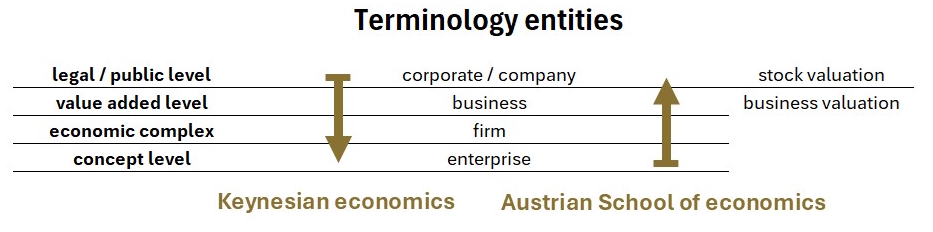
This corresponds to the socialist Marx doctrine, according to which a context hypothesis is given from above based on the collectivist macroeconomic view, resulting in a society that runs a business, which is a firm, and from which the company is defined.
The entrepreneur’s approach is completely different and is called entrepreneurship!
Subsequently, the entrepreneur, based on an individualistic microeconomic perspective, formulates a context hypothesis for something new and creates a new demand and thus his own aggregated demand.
This corresponds to the market-oriented doctrine of the Austrian School, according to which a contextual hypothesis is not simply connected and is created from the bottom up, starting with a microeconomic analysis. From this emerges a enterprise, which is a firm that operates a business and is therefore a society.
The entrepreneur must therefore necessarily bring something new into the world in order to generate new demand. This means that the entrepreneur’s field of activity is always risky, because it only becomes clear retrospectively whether the new contextual hypothesis has generated new consumption on the side of the return on investment.
Abstract labor is the tension between the Net Assets and the Capitalized Earnings.
With my Venture Aroma Filter, I have created a unique experimental setup. The product’s novelty lies not only in its patentability and the copyright on the term “Aroma Filter,” but also in the fact that it represents a new product category, which has prompted a change in the German Federal Institute for Risk Assessment’s (BfR) assessment of filter papers.
Purely through spontaneous order, the venture has obtained proof of technology and proof of product, thus demonstrating for the first time how intrinsic value has been created without distorting power imbalances through equity capital.
Net Asset value and Marx’s value-form (LTV) can be isolated from each other for the first time in this experiment, and the entrepreneur’s wage form, which was his economic value-added contribution (EVA), consequently the abstract labor, to the production of the new context hypothesis, can be empirically measured.
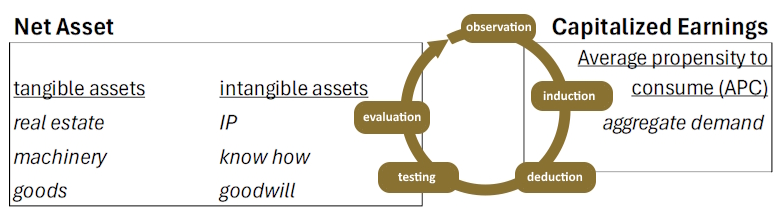
Adding a new category of goods (context hypothesis) to the economic complex qualitatively increased the money supply. Research now focuses on empirically demonstrating this theoretical increase in the money supply through the practical introduction of prototypes into circulation.
I have already founded an enterprise and guided it across the Mises-Hayek boundary as a new firm. If this now turnsover itself abstractly as business through activity within the economic complex, it will become a company and proves the theories of the Austrian School of Economics right.
To study my theory in more detail, I recommend the scientific concepts of “socioeconomic fractal research” and “entropieneurship”, which are available for download in the graphics below.